Trucking
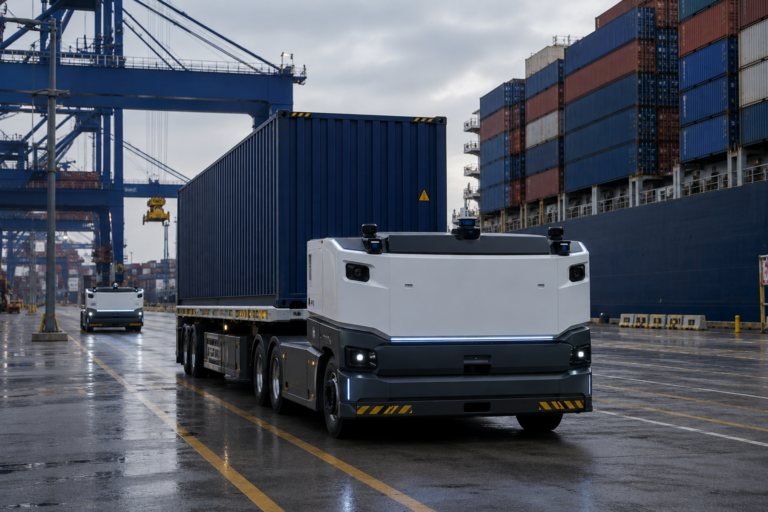
Software augmented testing built for autonomous trucking.
Real-fidelity neural reconstructions and deterministic sensor simulation to test and validate heavy-duty autonomous trucks across every freight corridor, weather pattern, and traffic scenario you can’t afford to fail in.
Why simulation, for trucking specifically
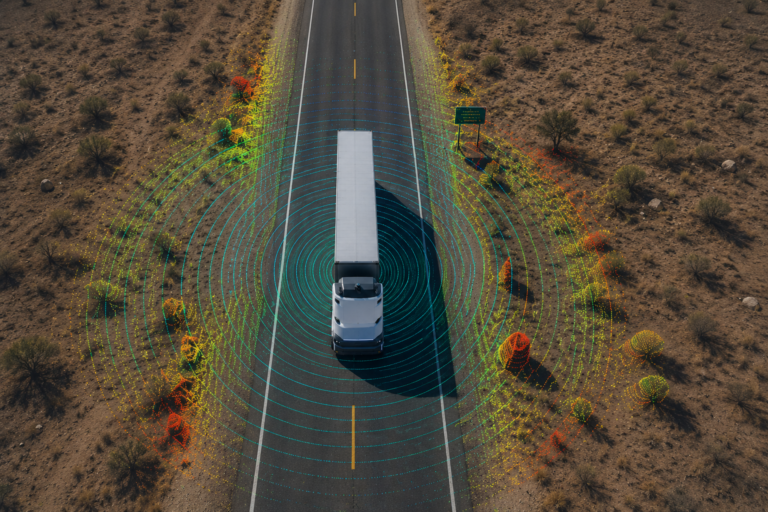
Safe, reliable perception
Long-haul exposure scale. Trucking AV programs need coverage across hundreds of millions of miles, dozens of corridors, and every weather pattern between Laredo and Tacoma. Physical fleets can’t get there fast enough.
Class 8 stopping distances. Heavy-duty trucks at highway speed need the length of a football field to stop. Perception failures at 70 mph have no recovery margin.
Long-tail corridor conditions. Sun glare on I-40, weather coming over Donner Pass, a trailer cutting your blind spot at a freight terminal. None of this reproduces on a closed track.
Solution — Run perception, prediction, and planning stacks against thousands of variations of the highest-risk corridor and terminal scenarios, in deterministic, repeatable simulation.
Time and cost
Real-world testing of Class 8 AV trucks costs millions per pilot — every fleet mile is a logistical and safety expense.
Capturing diverse corridor data across geographies and weather conditions takes years of fleet operations.
Hours-of-service rules, freight schedules, and terminal access constraints cap how many test miles you can collect.
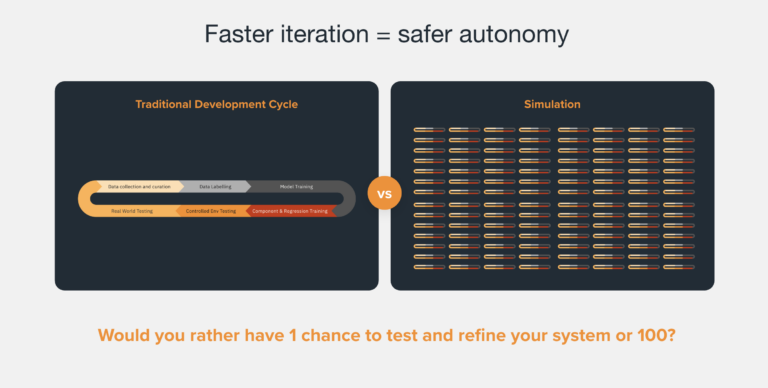
Solution — Turn a year of corridor coverage into a week of regression runs. Test more scenarios per dollar and ship safer, faster.
Scalability across corridors and configurations
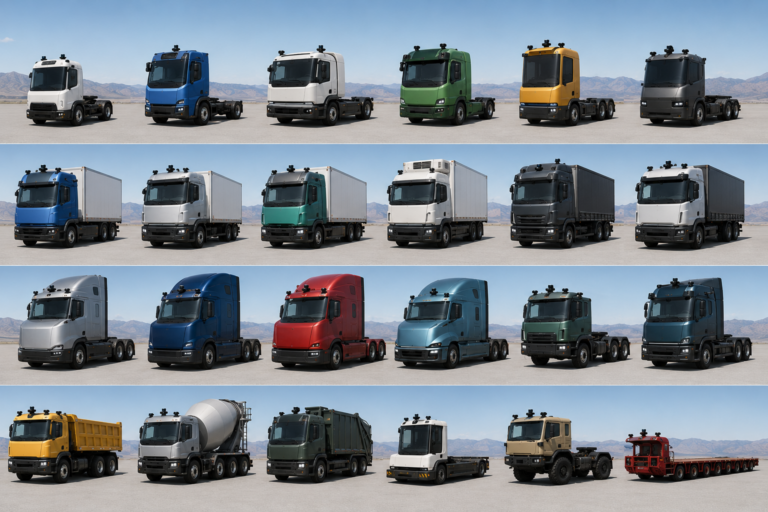
Different truck cab platforms, sensor rigs, and trailer configurations require separate validation campaigns.
New corridors, weather conditions, and operational design domains mean new data collection and re-validation cycles.
Defensible AV trucking deployment requires repeatable, measurable evidence — not anecdotes from a single pilot.
Solution — Test perception across freight networks, sensor rigs, cab variants, and ODDs by updating configuration, not recapturing data.
PD Replica + PD Sim for autonomous trucking pilots and validation programs.
Evaluate
Analyze
Train
Addressing trucking AV challenges
Accelerate development without scaling the physical fleet
Scale across corridors, sensor rigs, and cab platforms
Build trust in heavy-duty AV trucks
Schedule a Demo
Walk us through your trucking AV program and we’ll show you how PD plugs into your validation pipeline.