How Parallel Domain Utilizes NVIDIA Technology to Deliver Production-Grade Software to Physical AI Developers
If you are building a Physical AI system, you have probably discovered an uncomfortable truth: your real-world sensor data is never as clean as the papers assume. We exist to turn our messy reality into a true “Parallel Domain”: a digital reconstruction of reality that can be trusted to test and validate autonomous systems. Customers across automotive, drone delivery, eVTOL, agTech, last-mile delivery, and robotics trust us, and NVIDIA is an enabling partner key to improving our product and operating at scale.
Grounded in Reality: Deterministic Testing and Validation
Our PD Replica product creates pixel-accurate digital twins from customer-provided sensor logs. These real-fidelity digital twins close the sim-to-real gap in a meaningful way enabling production-grade testing and validation at scale. These are not visual approximations; they are geometrically accurate, simulation-ready environments with matched lighting, a physics mesh, and segmentation, reconstructing real-world locations and dynamic agents as faithfully as possible.
Once a scene is reconstructed, PD Sim enables fully deterministic testing and validation. When a real-world disengagement occurs, our customers can reconstruct the exact scene where the failure happened, then systematically debug it one variable at a time. We call this the Failure Flywheel. If a perception stack fails on a pedestrian obscured by shadow, the question is not just “can we fix this specific case?” but “did it fail because of the shadow, the pedestrian’s clothing, the lighting angle, or the timing?” With PD Sim, developers run programmatic parameter sweeps across thousands of variations, swapping agents, adjusting timing, and more. The goal is to isolate the root cause and verify that a fix is robust across the full distribution of possible scenarios.
This is not about hoping the system handles it better next time. It is about achieving deterministic confidence, demonstrating with high confidence that a specific vulnerability has been addressed across a wide range of conditions. Once validated against one reconstructed location, the fix can then be verified across the customer’s entire operational design domain using additional PD Replica environments. This auditable, repeatable process is the backbone of safety-critical autonomous system development, and it is what our production customers depend on every day.
Improving Reconstruction Quality with NVIDIA Technologies
The quality of any simulation is only as good as the quality of the scene reconstruction it is built upon. In production environments, customers rarely provide perfect input data. Sensors have blind spots, occlusions are unavoidable, and capturing every angle of a dynamic environment is often impossible. Traditional reconstruction methods can struggle with these gaps, leading to visual artifacts or inaccurate geometry when rendering viewpoints that were not explicitly captured by the original sensors. At Parallel Domain, we have developed proprietary techniques specifically designed to handle imperfect input data and still produce high-quality reconstructions. We excel at rendering novel viewpoints and support full multi-sensor simulation across radar, lidar, and RGB cameras within a single unified environment.
NVIDIA Omniverse NuRec Fixer, a diffusion-based model built on the NVIDIA Cosmos Predict world foundation model, has become a powerful addition to our pipeline. Integrated directly into the PD Replica workflow, Fixer removes rendering artifacts and restores detail in under-constrained regions of a scene. It is particularly effective at handling novel poses and off-axis views, the angles that the original capture never saw but that are critical for rigorous simulation testing. In our internal evaluations, the results have been significant: Fixer sharpens dynamic objects, smooths out noise, and reduces color space shifts, producing scenes that are truly simulation-ready. This improvement in geometric accuracy means that Physical AI developers can trust that an obstacle in simulation will trigger the same response it would in the physical world.
Looking ahead, we are also exploring additional NVIDIA Omniverse NuRec models such as Asset Harvester to continue strengthening our reconstruction pipeline. NVIDIA provides building blocks that allow us to continuously raise the bar on reconstruction quality, while we focus on integrating these capabilities into a production-grade platform that our customers can depend on.
Expanding the Envelope: NVIDIA Cosmos Transfer for Scene Variation
Deterministic validation with PD Sim is the core of what we deliver. But autonomous systems must also operate safely across an extraordinary range of real-world conditions, and capturing every possible variation through real-world data collection alone is impractical, costly, or simply impossible. Developers need breadth in addition to depth.
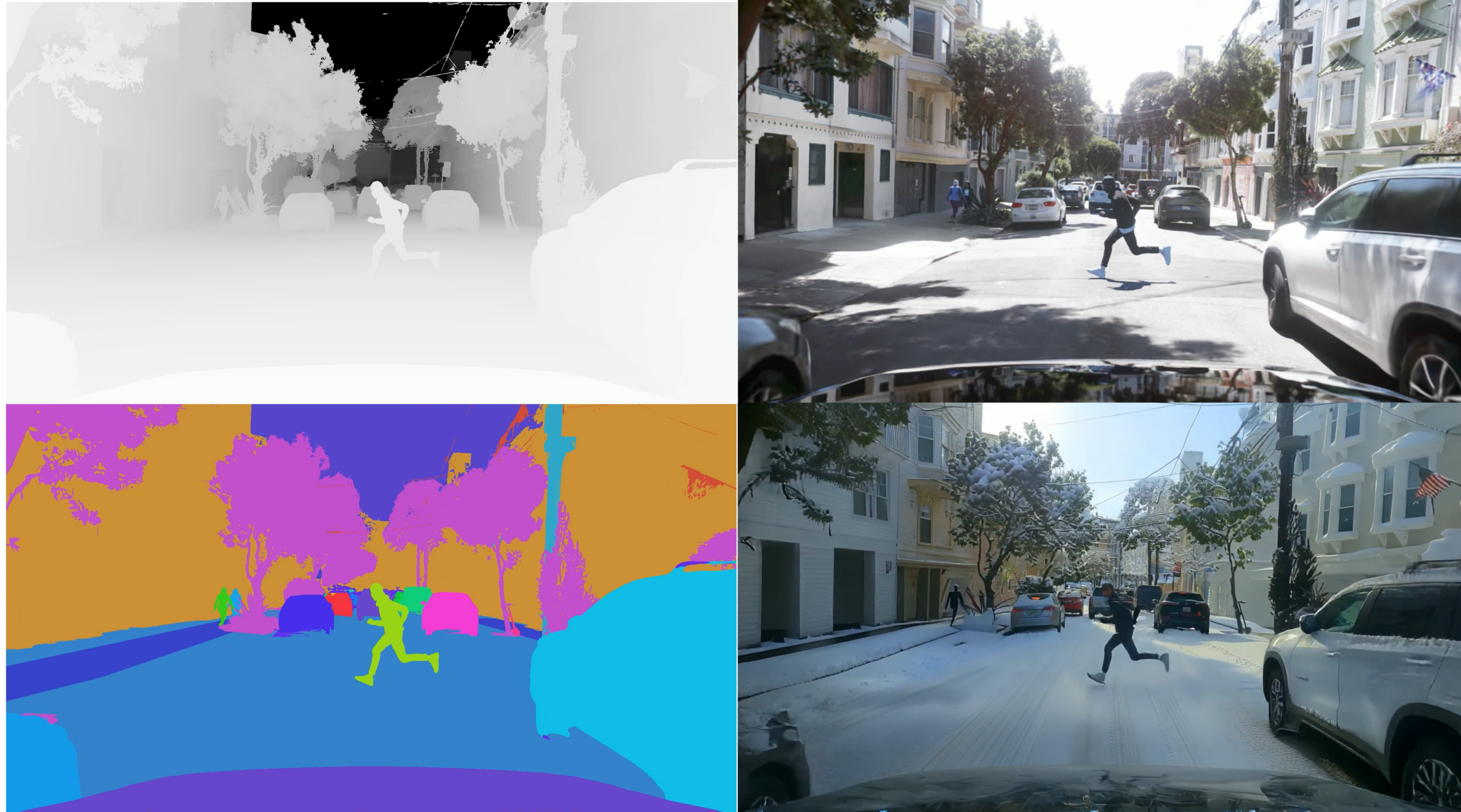
This is where the NVIDIA Cosmos Transfer world foundation model adds significant value. Cosmos Transfer enables text-conditioned environmental variations from a single reconstructed scene, transforming clear-weather captures into convincing variations with rain, fog, snow, or different times of day. By conditioning video generation on ground-truth structural inputs like segmentation masks and depth maps, Cosmos Transfer maintains core scene characteristics while modifying environmental details, providing a scalable way to generate realistic scenario variations that would be prohibitively expensive to capture in the real world.
Crucially, Cosmos-driven scene variation complements rather than replaces the deterministic validation provided by PD Sim. The workflow is additive: use Cosmos Transfer to expand the envelope of environmental conditions tested, generating diverse training data and broadening test coverage. Then use PD Sim and PD Replica to rigorously and deterministically validate system performance within that expanded envelope. Generative variation provides the breadth; deterministic simulation provides the auditability and confidence that safety-critical development demands.
Powered by NVIDIA: From Reconstruction to Simulation at Scale
Beyond the specific capabilities of Fixer and Cosmos Transfer, NVIDIA AI infrastructure underpins our entire workflow. Processing scene reconstructions from raw sensor data is computationally intensive work. Running thousands of deterministic simulation variations at the scale our customers require demands significant GPU resources. NVIDIA provides both the core libraries for physics simulation and the cloud-scale GPU clusters that make it possible to deliver performant simulation in production cloud environments. From processing a single scene reconstruction to running validation campaigns across an entire operational design domain, NVIDIA hardware is what makes it possible to deliver these capabilities at scale.
This initiative with Parallel Domain and NVIDIA is not about any single feature or integration. It is about an enabling relationship that allows us to deliver production-grade simulation to Physical AI customers. NVIDIA provides the foundation models, the physics libraries, and the compute infrastructure. We bring the production-grade software, the proprietary reconstruction techniques, and the deep understanding of what it takes to serve customers building safety-critical autonomous systems. Together, we are helping Physical AI developers accelerate their path to safe, reliable deployment.
Visit Parallel Domain at NVIDIA GTC booth 1647 to see our latest capabilities in action, or request a demo.