Introducing PD Forma: 4D reconstruction, scored against reality.
Today we are introducing PD Forma, the platform that turns your own capture logs into program-scale PD Replicas. Bring a raw drive, or flight log; PD Forma validates it, reconstructs it, scores it agains the source footage, and publishes a simulation-ready Replica into PD Sim.
PD Forma was developed with two design partners who began running it on their own drive logs. It now builds every new Replica we deliver.
The timing matters. Fleets record millions of miles of exactly the scenarios simulation teams struggle to hand-build, and nearly all of it is used once and archived, because turning a log into a test environment has been a research project rather than a workflow. With PD Forma it is an overnight job. One minute of driving becomes hours of controllable simulation, one log becomes a permanent test track, and a real-world failure becomes a repeatable experiment you can replay and vary until the root cause falls out.
Replicate the scenario
A PD Replica captures more than the road. Moving vehicles in the log are reconstructed as separate actors, each with its own 3D bounding box and extracted trajectory, ego vehicle included. The result is a scene you can replay exactly as it was captured, or vary: hold the environment constant and change what the other agents do. We wrote about why that loop matters in The Failure Flywheel.
In the viewer below, the point cloud is the reconstructed environment and the colored boxes are the dynamic agents PD Forma extracted from the same log, with their paths drawn through the scene. Drag to orbit, scroll to zoom, or switch to the ego camera to see the scene the way the vehicle did.
Validate the sim-to-real gap
Every Replica ships with a quality report, generated by the pipeline and reviewed by your team before you accept the reconstruction. A flythrough that looks good is not evidence. A report that scores the Replica against the footage it came from is.
The qualitative view puts the original capture and the rendered Replica side by side, frame for frame, so you can see where the reconstruction holds and where it does not. Below it, per-frame distributions of PSNR and LPIPS across every camera show how consistent the Replica is over the whole dataset, and the best and worst samples point you straight at the frames worth inspecting. Press Compare to scrub both videos in lockstep.
The quantitative view breaks the same metrics down per camera, so a rig with a weak sensor, a rolling-shutter artifact, or a bad calibration shows up as a number rather than a surprise in the simulator. Every figure in this report was produced by the pipeline for the Replica above, with no manual curation.
Alter the environment
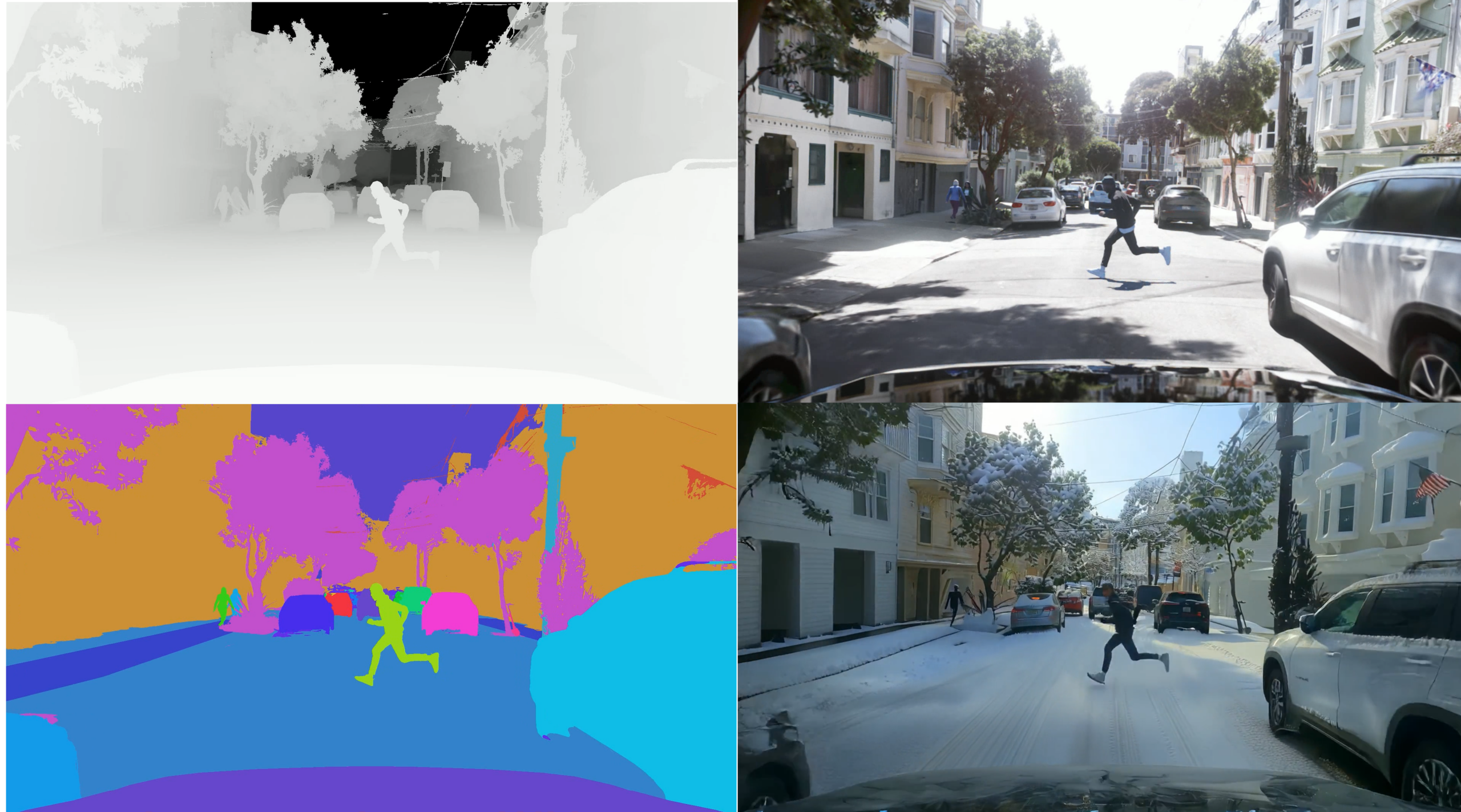
The same Replica, under different conditions. This Panda 124 experiment includes cloudy, dawn, dusk, rain, snow and sunny variations while holding the reconstructed geometry constant. That lets a team test how the same real-world scene behaves as lighting and weather change.
The Replica below is rendered as Gaussian splats, vehicles included. Use the variant selector to switch between the original capture conditions and the six variations from this job.
Publish to PD Sim, sim at scale
Publishing is the last stage of the pipeline. Once a Replica passes its quality gates, PD Forma publishes it into PD Sim, where it becomes a permanent test location: a real-world scene rendered through PD Sim’s camera, lidar, and radar sensor models, with full annotations on every frame.
Below is the kind of output PD Sim produces: multiple camera views, including fisheye and telephoto lenses, with 2D bounding boxes and semantic segmentation on the front camera. Press play to step through the sequence.
The same frames from the lidar and radar. Every sensor in the rig sees one consistent world, and every point comes with ground truth.
Bring us a raw capture log
PD Forma runs the whole pipeline on real, messy captures, not curated benchmark data:
- Package and validate. Package logs with the SDK or CLI and validate them locally, with deterministic pass, warn, or fail results and specific fixes, before you transfer gigabytes.
- Submit and monitor. Submit against PD-maintained presets gated by compatibility checks, then monitor the run from the web app or the API.
- Recover without starting over. Stage logs show what broke. Fork from the last good stage instead of rerunning the whole job.
- Inspect and publish. Review the quality report, inspect the Replica in 3D, and publish it into PD Sim.
The same workflow runs driving, drone, and indoor scenes as presets, not rebuilds, and it scales. Several drive logs can be fused into one large-scale Replica, mixed cameras included.
Request a demo
Turn your raw capture logs into sim-ready dynamic reconstructions at scale